I’m your media friend, I’m with you to the rainbows end.
The Drug Apostles in print and online. Interviews, reviews and evidence that somebody noticed.
Nachtfragment
Click the image to read the review on the publication’s website.
Nachtfragment is an independent German dark music publication based in Hamburg, featuring reviews, interviews, new artists, music videos and underground sounds.
Nachtfragment Review 9/20
The Drug Apostles – Sermons in Noise
Punk, Industrial and the Sound of a Pretty Broken World
The Drug Apostles sound like someone took all the noise, frustration and chaos of the world, plugged it into an amplifier and simply refused to turn it down. Based in Iola, Kansas, the project moves somewhere between punk, industrial rock, post-punk, dark electronics and experimental hip-hop. It is loud, restless and deliberately difficult to put into one neat genre box.
Not really a band
The Drug Apostles are not a conventional band in the usual sense. The project describes itself as a theatrical production, where the EP is the play, the instruments become the actors and the music becomes the script. Different musicians can take on different roles and characters, while the whole thing remains part of one larger concept.
That theatrical side is a big part of what makes The Drug Apostles interesting. Characters such as Gultchy Amore, Sonic Jesus, Remus and Romulus, Kaptain Skipper and DJ Fuck You become different faces within the project. It feels less like a traditional band biography and more like entering a strange little universe that has its own rules.
Racing Thoughts
The 2026 release “Racing Thoughts” pushes that idea into a particularly aggressive direction. Punk energy meets industrial noise, heavy guitars, huge drums, grinding bass and electronic textures. There are also traces of experimental hip-hop and a general feeling of dystopian rock.
The title fits the music. Everything seems to be moving at once. Thoughts collide, the rhythm keeps pushing forward and the production often feels intentionally overloaded. It is not music that wants to create a comfortable atmosphere. It feels more like a soundtrack for overstimulation, paranoia, exhaustion and emotional collapse.
And honestly, that is probably where The Drug Apostles work best for me: when everything becomes a little too much.
Somewhere between punk and industrial
There is definitely punk at the heart of the project, but The Drug Apostles do not stay there. Industrial sounds, dark electronics, experimental structures and distorted rock constantly pull the music somewhere else.
The result is rough around the edges, sometimes chaotic and sometimes surprisingly theatrical. It does not feel like a project trying to reproduce a particular scene or copy an established sound. Instead, it takes elements from different corners of underground music and throws them into the same room.
That makes the music unpredictable, but also gives it character.
Iola, Kansas
The fact that The Drug Apostles come from Iola, Kansas is more than just a location on a Bandcamp page. The project repeatedly connects its identity with its surroundings and with the feeling of creating something different from what might normally be expected there.
You can hear that tension in the music. There is a sense of isolation, resistance and wanting to create your own space. The Drug Apostles turn that atmosphere into something loud and confrontational rather than hiding it.
A concept that actually works
What I like about The Drug Apostles is that the theatrical concept does not simply sit on top of the music as decoration. The characters, the visual identity and the music all seem to belong to the same strange world.
It is messy, dark, sometimes absurd and deliberately excessive. But underneath all of that there is a very clear musical identity: distorted guitars, industrial textures, punk aggression, electronic noise and a feeling that something is constantly about to fall apart.
My way in
For me, “Racing Thoughts” is the obvious place to start. It shows very well what The Drug Apostles are doing right now: aggressive, experimental, dystopian and impossible to reduce to a single genre.
The Drug Apostles are not trying to make things comfortable. And maybe that is exactly the point.
No clean sound. No safe box. Just noise, punk, industrial and a pretty broken world.

The Iola Register is an independent, family-owned newspaper serving Iola and Allen County, Kansas. Founded in 1867 as The Allen County Courant, it became The Iola Register in 1875. For more than 150 years, it has documented the community’s news, people and history.
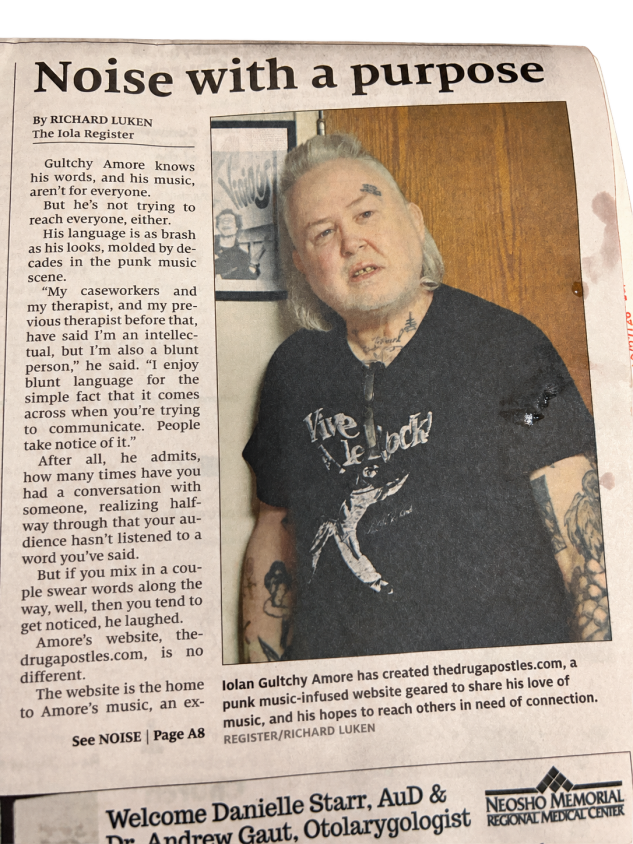
Noise with a purpose
By Richard Luken
The Iola Register
Print edition, Saturday, October 3, 2026
Gultchy Amore knows his words, and his music, aren’t for everyone.
But he’s not trying to reach everyone, either.
His language is as brash as his looks, molded by decades in the punk music scene.
“My caseworkers and my therapist, and my previous therapist before that, have said I’m an intellectual, but I’m also a blunt person,” he said. “I enjoy blunt language for the simple fact that it comes across when you’re trying to communicate. People take notice of it.”
After all, he admits, how many times have you had a conversation with someone, realizing halfway through that your audience hasn’t listened to a word you’ve said.
But if you mix in a couple swear words along the way, well, then you tend to get noticed, he laughed.
Amore’s website, thedrugapostles.com, is no different.
The website is the home to Amore’s music, an experimental punk band and noise project — part autobiography, part music and part words of support for others who might be in his position.
“That’s why I’m doing this,” he explained. “I have to be brave to reach out to other people who may be in a similar situation.”
Not all have responded favorably.
“But I can’t let that stop me,” Amore said.
As one might expect, Gultchy Amore isn’t his real name, but rather a pseudonym.
He keeps the stage name for his public persona out of respect for his family members, many of whom remain at odds with the 57-year-old’s punk music lifestyle.
“They don’t like this,” he said.
AMORE knew at a young age he was a bit different than his classmates.
He grew up a military brat, bouncing around to various locales across the country, before settling in southern California.
It was a struggle to fit in, even with his family members, but especially with his classmates.
He looked and acted a bit different.
Amore’s doctors diagnosed him as hyperactive.
“They put me on Ritalin and all this other stuff, and gave me weird diets,” he recalled. “Kids made fun of me because I couldn’t sit still.”
It wasn’t until years later he was diagnosed with bipolar disorder — which was of little solace to a youth with nowhere to connect.
And by the time adulthood came around, that confusion and hurt had long since turned to darkness, and a healthy contempt for society in general.
AMORE found his first true connection around 9 or 10, and it came in the form of punk music.
The music coming through the speakers was unlike anything he’d heard before, these chaotic and abrasive — yet surprisingly musically proficient — sounds from groups like Dead Kennedys or Black Flag.
He admits he’s likely misunderstood the nuance of many of those songs, the hidden satire.
Nevertheless, Amore found for the first time in his life that there were others like him out there in this crazy world.
The misfits, angry at The Man, were ready to be heard.
“It’s more of a lived philosophy,” he said. “And you either live it, or you don’t.”
He lived it.
“I remember visiting my grandparents once, and soon as I got off the bus, they saw me in my punk rock uniform,” he said. “I think I had a mohawk at the time, which is socially acceptable now, but back then, they thought I was from Mars.”
He garnered a bit of local fame as a youth in his music groups, taking up the bass as his instrument of choice.
Over time he hooked up with a number of bands and solo performers on the local music scene.
“Those were wild nights filled with noise, energy and the sweet chaos of underground music,” he wrote on his website.
Life intervened along the way. He dropped out of high school, quickly earning his GED and passing his life insurance exam on the first try.
He got married, then divorced, and had a couple of kids.
But music was never far away.
Amore worked as a freelance stagehand in Los Angeles, joining production teams, and doing other odd jobs.
“I could be doing anything from getting people’s laundry to driving rock stars around town,” he recalled.
The work was often feast or famine, “but I got to make my own schedule, and I enjoyed that.”
THE BOTTOM fell out during the COVID pandemic, when the live music scene in Los Angeles vanished overnight.
Living in southern California, and its high cost of living, is doable, when you’re earning a steady income.
But even with unemployment, such existence was impossible.
He moved to Iola, with his mother and stepfather, when life threw him another curveball, on top of dealing with his bipolar disorder, Amore also was dealing with diabetes.
“What happened was I had a stroke in one of my eyes,” he said. “The tissue around my optic nerve swelled up and choked out the nerve entirely.”
The damage to his left eye was permanent.
“Doctors say if my vision comes back, it will be maybe 5% of what it was,” he said.
Then, within weeks, the vision in his right eye began to fade, too.
He’s now legally blind.
Darkness began to descend in other ways, too.
Amore rarely left his bedroom, leading to dissension with his family members.
Suddenly, it became much less important to take his medication. Any hope for a happy ending gave way as neuropathy, heart disease and vasculitis soon set in.
HIS SALVATION came in the form of a caseworker from the Southeast Kansas Mental Health Center, who convinced Amore that there was still plenty to live for.
With assistance from Thrive Allen County, Amore was able to qualify for disability benefits, and has since moved out on his own to a rent-controlled apartment.
His caseworkers and therapists have been a godsend. So has Roach, his 2½-year-old dachshund, whom he got shortly after moving into the apartment. Roach was named after the titular character’s sidekick in the Pixar film “Wall-E.”
“They’ve helped me cope with some very difficult things to deal with, especially with the upswings and downswings,” he said.
As has the music.
And while his vision impairment has largely sapped his ability to play guitar, Amore found another music-making tool, Garage Band.
The iPad app allows a performer to record and mix his own music. Suddenly, he was writing, arranging and engineering and releasing his artistry into the ether.
That, in turn, led to The Drug Apostles, Amore’s outlet for the music, as well as for an opportunity to reflect on life, his story, and whatever else he feels like sharing.
He and several of his friends from his punk music days have collaborated on a number of songs.
Mostly, though, he hopes his music, and his message, finds a particular type of audience, those who may be in his shoes.
“Everything connected to Drug Apostle is built by one person sitting alone in a room with an iPad,” he said. “The band will never play live. And fame isn’t really the goal. Respect from peers would be enough.
“Perhaps a few listeners somewhere in the vast digital sea who hear the signal through all the noise,” he continued. Because making music today can feel like shouting into a giant void. But sometimes, tiny dragons, the void answers back.”
Photo caption
Iolan Gultchy Amore has created thedrugapostles.com, a punk music-infused website geared to share his love of music, and his hopes to reach others in need of connection.
Photo credit, Register/Richard Luken.
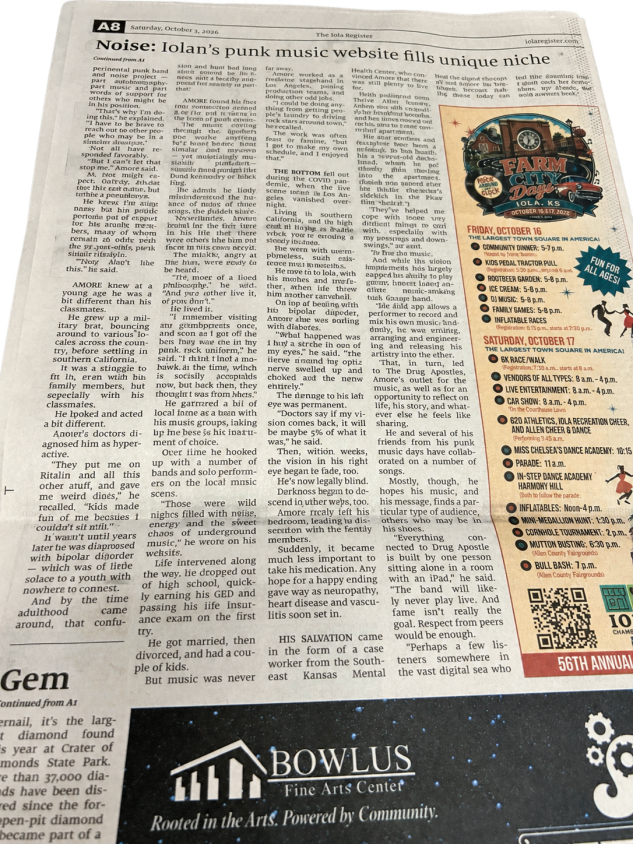
Continuation headline, page A8
Noise: Iolan’s punk music website fills unique niche